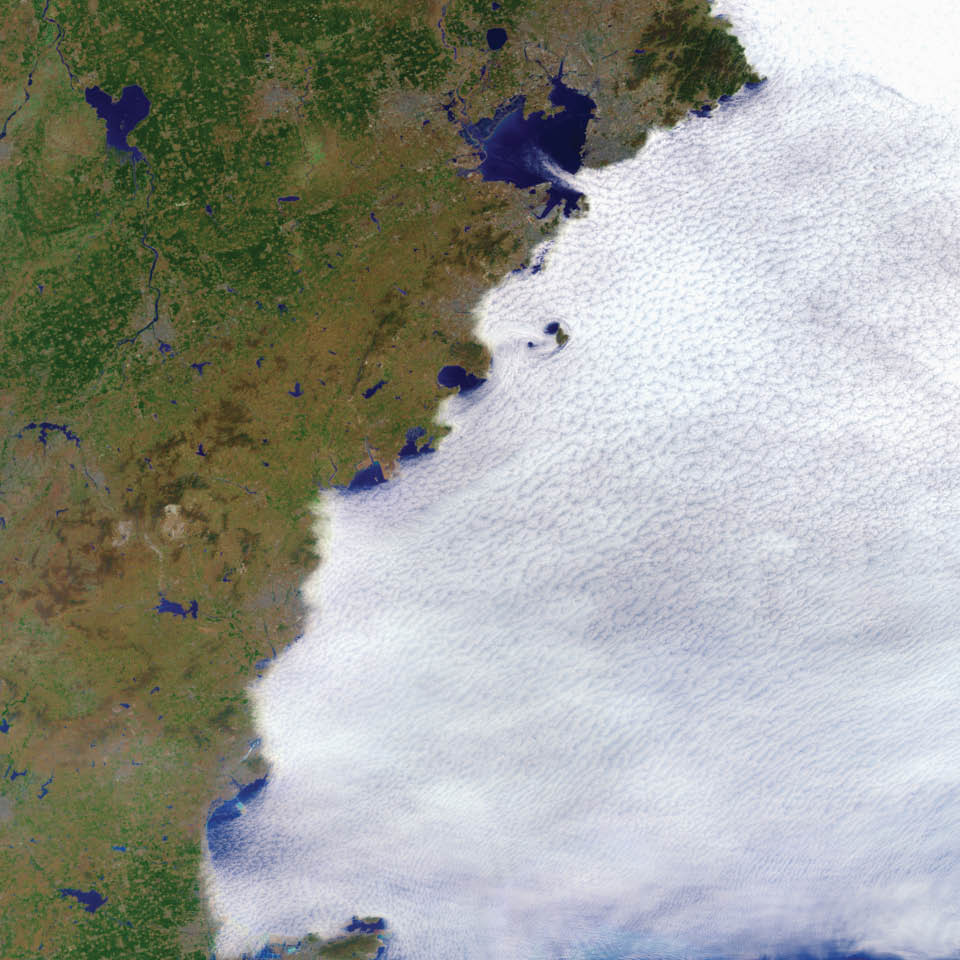
海洋一整天的升温幅度远不如陆地。正因如此,凉而湿的海洋气团常在洋面上方凝出浓密的云。
The ocean does not heat up as much throughout a day as landmasses do. For this reason, cool, moist marine air commonly gives rise to dense clouds over the ocean.
图中是中国沿海。向岸风把云从海上推向陆地,但陆地更暖、更干,不利于成云。于是移入内陆的海洋云很快消散,只留下一层贴着海岸线形状的云。
In this example from the coast of China, an onshore wind carries the clouds from the ocean toward the land. But the land is warmer, drier, and unfavorable for cloud growth. As a result, the marine clouds that move onshore tend to evaporate, leaving a cloud layer that traces the coastline.
原文:Michael Carlowicz、Lawrence Friedl、Kevin Ward《Earth》,NASA Headquarters, Earth Science,2018 年(NP-2018-05-2546-HQ;ISBN 978-1-62683-047-9)。
原文授权:依《美国法典》第 17 编第 105 条(17 U.S.C. §105),原文在美国境内不受版权保护,属公有领域(public domain)。NASA 媒体使用指南允许将其用于教育与资讯用途(含图集、教材、展陈与网页),并要求注明 NASA 为来源;商业用途另受限制。
图像:NASA Earth Observatory、NASA/USGS Landsat、国际空间站(ISS)、Suomi NPP、NASA/METI/ERSDAC/JAROS 等,均为 NASA 发布的公有领域影像;逐幅来源见原书 Credits 页。
标识:NASA 徽标(Insignia)、Logotype 与相关标识不属公有领域,受法律保护;本文未使用,亦不代表 NASA 立场。
本文:本文为非商业用途的个人独立翻译、校对与排版,不代表 NASA 立场;NASA 未审阅、未认可或背书本译文。
译文授权:译文与排版由译者独立完成,著作权归译者所有,按 GNU 通用公共许可证第 3 版(GPLv3)授权分发;许可证全文见 https://www.gnu.org/licenses/gpl-3.0.html。转载、修改或再分发请同样遵循 GPLv3。
Original work: "Earth" by Michael Carlowicz, Lawrence Friedl and Kevin Ward (NASA Headquarters, Earth Science, 2018; NP-2018-05-2546-HQ). Under 17 U.S.C. §105 the original is not subject to copyright protection in the United States and is in the public domain there. NASA media guidelines permit educational and informational reuse (image collections, textbooks, exhibits, web pages) with acknowledgement of NASA as the source, and restrict commercial use. The NASA Insignia, Logotype and identifiers are protected by law and are not used here. This edition is a non-commercial, independent Chinese translation and typesetting; it does not represent NASA. Translation and typesetting © the translator, distributed under the GNU General Public License v3.0 (https://www.gnu.org/licenses/gpl-3.0.html).