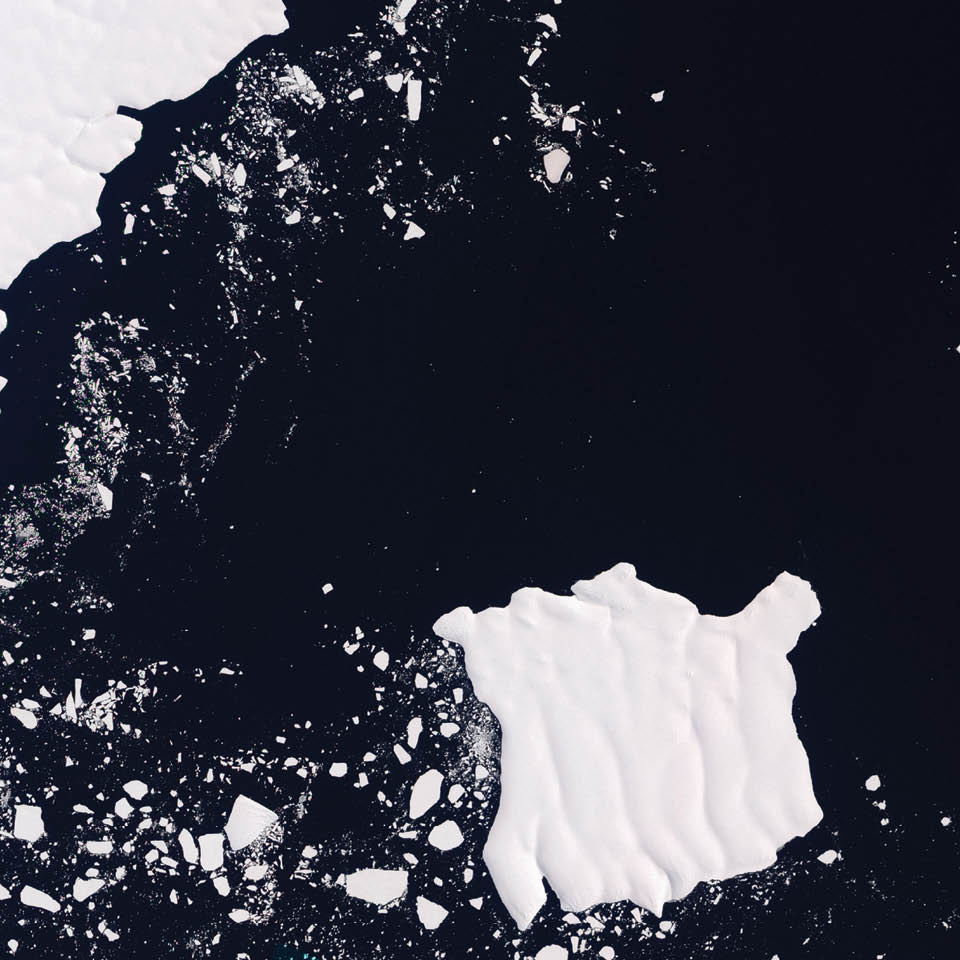
默茨冰川(Mertz Glacier)从东南极洲流出,伸出一条狭长的冰舌,朝着澳大利亚与新西兰的方向。这条冰舌时常朝大洋崩解出冰山——2010 年 1 月,地球观测一号(Earth Observing-1)恰好拍到了这一幕。
The Mertz Glacier flows off East Antarctica and forms a long, narrow tongue pointing in the direction of Australia and New Zealand. That tongue routinely calves icebergs into the Southern Ocean, and the Earth Observing-1 satellite spotted it doing just that in January 2010.
深深的裂隙把冰舌表面刻得粗糙崎岖,这份质地也带到了这座波纹起伏的冰山上。这类冰块常被环绕南极的洋流带走;只要还在够冷的地方,冰山能保持大半年乃至数年不散。也有些冰山一路北漂进暖海,最终崩解。观察冰山对温暖的回应,科学家便能推测冰架——贴在海岸线上的厚冰板——在气候变暖时会怎么反应。
Deep cracks, or crevasses, give the glacier tongue a rough and rugged texture, which carried over to this rippled iceberg. Such ice is often swept up by ocean currents circling Antarctica, and icebergs can remain relatively intact for months or years, so long as they remain in sufficiently cool conditions. Some icebergs, however, drift northward to warmer climates and disintegrate. By observing the response of an iceberg to warmer conditions, scientists can make predictions about how ice shelves—thick slabs of ice attached to coastlines—might respond to a warming climate.
原文:Michael Carlowicz、Lawrence Friedl、Kevin Ward《Earth》,NASA Headquarters, Earth Science,2018 年(NP-2018-05-2546-HQ;ISBN 978-1-62683-047-9)。
原文授权:依《美国法典》第 17 编第 105 条(17 U.S.C. §105),原文在美国境内不受版权保护,属公有领域(public domain)。NASA 媒体使用指南允许将其用于教育与资讯用途(含图集、教材、展陈与网页),并要求注明 NASA 为来源;商业用途另受限制。
图像:NASA Earth Observatory、NASA/USGS Landsat、国际空间站(ISS)、Suomi NPP、NASA/METI/ERSDAC/JAROS 等,均为 NASA 发布的公有领域影像;逐幅来源见原书 Credits 页。
标识:NASA 徽标(Insignia)、Logotype 与相关标识不属公有领域,受法律保护;本文未使用,亦不代表 NASA 立场。
本文:本文为非商业用途的个人独立翻译、校对与排版,不代表 NASA 立场;NASA 未审阅、未认可或背书本译文。
译文授权:译文与排版由译者独立完成,著作权归译者所有,按 GNU 通用公共许可证第 3 版(GPLv3)授权分发;许可证全文见 https://www.gnu.org/licenses/gpl-3.0.html。转载、修改或再分发请同样遵循 GPLv3。
Original work: "Earth" by Michael Carlowicz, Lawrence Friedl and Kevin Ward (NASA Headquarters, Earth Science, 2018; NP-2018-05-2546-HQ). Under 17 U.S.C. §105 the original is not subject to copyright protection in the United States and is in the public domain there. NASA media guidelines permit educational and informational reuse (image collections, textbooks, exhibits, web pages) with acknowledgement of NASA as the source, and restrict commercial use. The NASA Insignia, Logotype and identifiers are protected by law and are not used here. This edition is a non-commercial, independent Chinese translation and typesetting; it does not represent NASA. Translation and typesetting © the translator, distributed under the GNU General Public License v3.0 (https://www.gnu.org/licenses/gpl-3.0.html).