大模型相关的名词越来越多,散在模型、训练、检索、部署、智能体几个方向,回头查起来很乱。这篇按用途把常见的术语分门别类整理一遍,每条给出简写、全称、含义和链接。第一个出现的是英文缩写时,全称栏里补上原文;不是缩写的,用「—」占位。整体上从最基础的模型概念,到最常见的本地部署,再到更深入的训练、应用和智能体;每一类内部按出现时间从早到晚排。
先看一张整体地图,把范围过一遍:
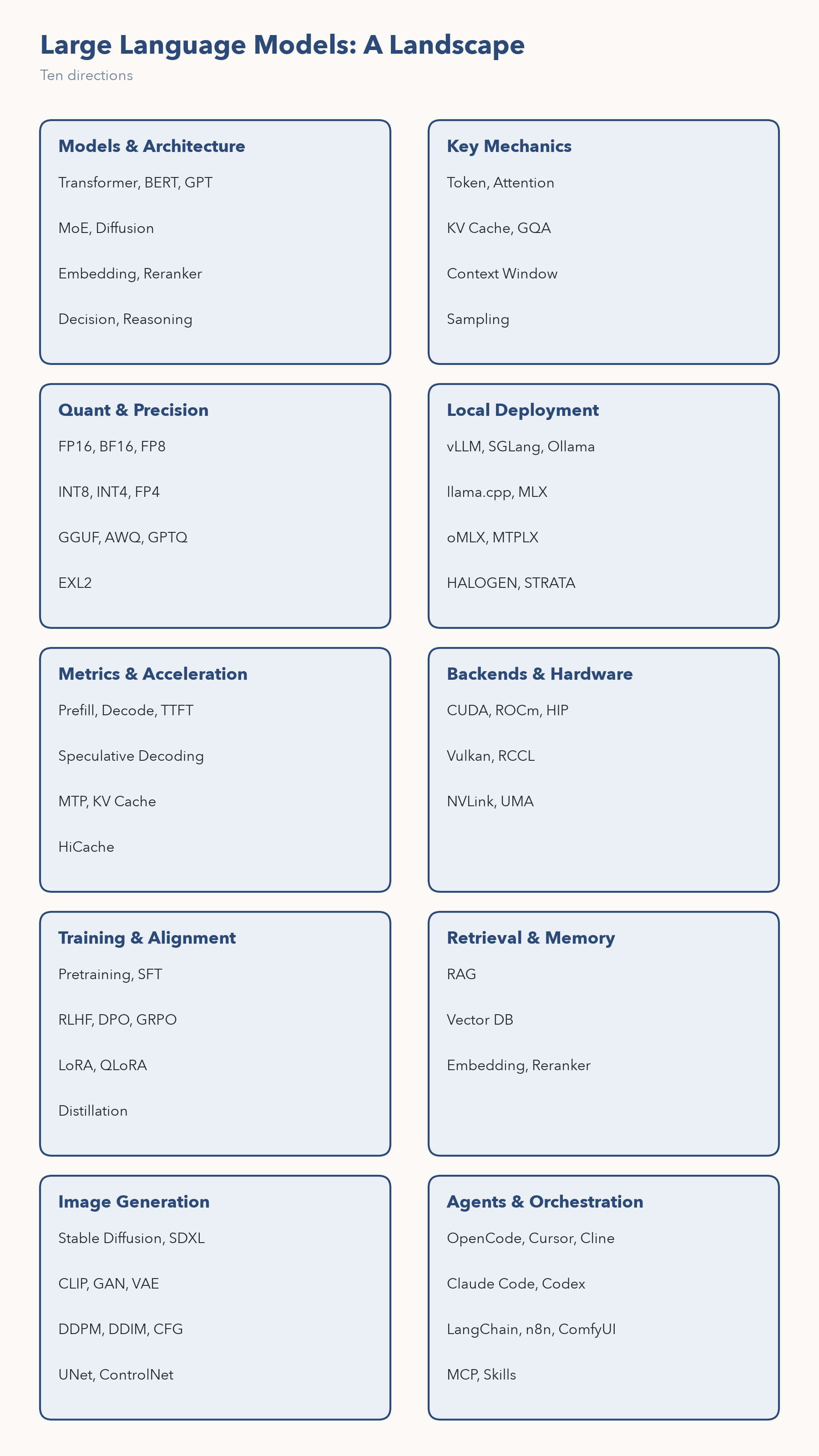
模型与架构
| 简写 | 全称 | 含义 | 链接 |
|---|---|---|---|
| Embedding | — | 嵌入,把文本变成向量,用于检索和相似度比较 | https://github.com/FlagOpen/FlagEmbedding / https://www.sbert.net |
| Transformer | — | 以注意力为核心的网络结构,2017 年提出,几乎所有大模型的基础 | https://arxiv.org/abs/1706.03762 |
| BERT | Bidirectional Encoder Representations from Transformers | 只用编码器、双向读整句,擅长理解类任务 | https://github.com/google-research/bert |
| GPT | Generative Pre-trained Transformer | 只用解码器、单向从左往右,擅长生成 | https://arxiv.org/abs/2005.14165 |
| LLM | Large Language Model | 参数量很大的语言模型,能生成、能对话 | https://huggingface.co/ |
| Reranker | — | 重排模型,对一批候选重新排序,先粗筛、再精排 | https://cohere.com/rerank |
| Diffusion | — | 扩散模型,从噪声一步步还原图像 | https://arxiv.org/abs/2006.11239 |
| MoE | Mixture of Experts | 混合专家,每次只激活一部分参数,省算力 | https://arxiv.org/abs/2401.04088 |
| Multimodal | — | 多模态,同时处理文字、图像、声音等 | https://arxiv.org/abs/2603.21687 |
| Reasoning | — | 推理模型,先想一长串中间步骤再回答 | https://arxiv.org/abs/2501.12948 |
| Decision / Judge | — | 决策模型,不写文本,直接给出选择、分数或概率 | https://jevmodel.org/ |
关键机制
| 简写 | 全称 | 含义 | 链接 |
|---|---|---|---|
| Token | — | 词元,把文本切成的单位 | https://github.com/openai/tiktoken |
| BPE | Byte Pair Encoding | 字节对编码,一种分词方法 | https://github.com/openai/tiktoken |
| WordPiece | — | 另一种分词方法,BERT 采用 | https://github.com/google-research/bert |
| Attention | — | 注意力,让每个词去看其他词;分自注意力、交叉注意力 | https://arxiv.org/abs/1706.03762 |
| KV Cache | Key-Value Cache | 键值缓存,缓存已经算过的键和值,避免重复计算 | https://huggingface.co/docs/transformers/ |
| Context Window | — | 上下文窗口,一次能读进去的最大长度 | https://huggingface.co/docs/transformers/ |
| Sampling | — | 采样,temperature、top_p 等,控制生成的随机性 | https://huggingface.co/docs/transformers/ |
| GQA | Grouped-Query Attention | 分组查询注意力,多个查询头共享键值,省显存 | https://arxiv.org/abs/2305.13245 |
模型参数与量化
跑本地模型,先要理解数值精度和量化格式,这两样直接决定显存和速度。
| 简写 | 全称 | 含义 | 链接 |
|---|---|---|---|
| FP16 | Half Precision (16-bit Floating Point) | 16 位浮点,常用精度 | https://developer.nvidia.com/cuda-toolkit |
| INT8 | 8-bit Integer | 8 位整数,量化里常用 | — |
| BF16 | Brain Floating Point 16 | 16 位浮点,动态范围更大,训练时更稳 | https://developer.nvidia.com/cuda-toolkit |
| bitsandbytes | — | 一个量化库,提供 8 位、4 位等低精度方案 | https://github.com/bitsandbytes-foundation/bitsandbytes |
| GPTQ | GPT Quantization | 一种后训练权重量化方法,常见的 4 位方案 | https://github.com/IST-DASLab/gptq |
| FP8 | 8-bit Floating Point | 8 位浮点,省显存、还能提速 | https://github.com/NVIDIA/TensorRT-Model-Optimizer |
| AWQ | Activation-aware Weight Quantization | 激活感知的权重量化,常见的 4 位方案 | https://github.com/mit-han-lab/llm-awq |
| GGUF | GPT-Generated Unified Format | llama.cpp 用的模型文件格式 | https://github.com/ggml-org/ggml |
| Q4_K_M | — | GGUF 的常规量化档位:Q 指量化,数字是位数;带 K 的是分块量化,S/M/L 是大小档。数字越小越省、也越糊 | https://github.com/ggml-org/llama.cpp |
| IQ2_XXS | — | GGUF 的 IQ 系列:用「重要性矩阵」分配精度,同体积比 Q 系列更保真 | https://github.com/ggml-org/llama.cpp |
| EXL2 | — | ExLlamaV2 引擎用的量化格式,面向消费级显卡 | https://github.com/turboderp-org/exllamav2 |
| INT4 | 4-bit Integer | 4 位整数,量化里常用 | — |
| NVFP4 | NVIDIA FP4 | 英伟达的 4 位浮点,进一步压显存 | https://github.com/NVIDIA/TensorRT-Model-Optimizer |
| MXFP4 | Microscaling FP4 | 微缩放的 4 位浮点,开放标准 | https://github.com/microsoft/microxcaling |
本地部署
跑本地模型,通常分两层:底层是推理引擎,往上是一批开箱即用的应用。
推理引擎
| 简写 | 全称 | 含义 | 链接 |
|---|---|---|---|
| Transformers | — | Hugging Face 的模型库,加载和微调几乎都用这个库 | https://github.com/huggingface/transformers |
| TGI | Text Generation Inference | Hugging Face 的推理服务 | https://github.com/huggingface/text-generation-inference |
| llama.cpp | — | 纯 C/C++ 推理,量化后能在消费级硬件上跑 | https://github.com/ggml-org/llama.cpp |
| llama-server | — | llama.cpp 自带的 HTTP 服务,方便本地起接口 | https://github.com/ggml-org/llama.cpp |
| vLLM | — | 高吞吐推理引擎,显存管理(PagedAttention)做得好 | https://github.com/vllm-project/vllm |
| MLX | — | 苹果芯片上的机器学习框架 | https://github.com/ml-explore/mlx |
| SGLang | — | 面向复杂流程和结构化输出的推理框架(名字取自 Structured Generation Language) | https://github.com/sgl-project/sglang |
| NInfer | — | C++/CUDA 推理引擎,社区移植到了不同显卡上 | https://github.com/Neroued/ninfer |
| oMLX | — | Mac(Apple MLX)上的本地推理框架,对 M 系列优化更深,自带 oQ4e/oQ5e/oQ6 量化和原生 MTP | https://github.com/jundot/omlx |
| MTPLX | — | Mac 上的本地推理服务,用原生 MTP 做投机解码,兼容 OpenAI / Anthropic 接口 | https://github.com/youssofal/MTPLX |
本地应用
| 简写 | 全称 | 含义 | 链接 |
|---|---|---|---|
| Ollama | — | 本地跑模型的一键工具 | https://ollama.com |
| LM Studio | — | 桌面端本地模型工具 | https://lmstudio.ai |
| Open WebUI | — | 本地模型的聊天前端 | https://github.com/open-webui/open-webui |
| HALOGEN | — | 为 AMD Strix Halo 定制的推理加速,专攻 Qwen3.8-Flash-Next | https://github.com/peonist-ai/halogen-flash-server |
| STRATA | — | 把 125B 的 Qwen3.8-Flash-Next 跑在普通电脑上,本地、量化 | https://github.com/Niko1221/Strata |
推理指标与加速
判断一台机器快不快,看几个指标;再往上,是各种加速和缓存手段。
| 简写 | 全称 | 含义 | 链接 |
|---|---|---|---|
| Prefill | — | 预填充,处理输入提示的速度,决定「读题」快慢 | https://docs.vllm.ai/ |
| Decode | — | 解码,逐词生成的速度,决定「答题」快慢 | https://docs.vllm.ai/ |
| TTFT | Time To First Token | 首 token 时间,从发出请求到第一个字出现 | https://docs.vllm.ai/ |
| tok/s | tokens per second | 每秒生成多少 token,口语里说的「速度」 | — |
| OOM | Out Of Memory | 显存不足,程序报错退出 | — |
| 简写 | 全称 | 含义 | 链接 |
|---|---|---|---|
| Speculative Decoding | — | 投机解码,先草拟若干个词,再让大模型一次校验 | https://arxiv.org/abs/2211.17192 |
| MTP | Multi-Token Prediction | 多词元预测,模型自带的多词预测能力,做投机解码不用额外草稿模型 | https://arxiv.org/abs/2412.19437 |
| Draft Model | — | 草稿模型,投机解码里负责草拟的小模型;社区叫 DFlash / DFlash2、DSpark 等 | https://github.com/ggml-org/llama.cpp |
| Prompt Cache | — | 前缀缓存,把公共前缀的 KV 缓存下来,重复内容不再重算 | https://docs.sglang.ai/ |
| Radix Tree | — | 前缀树缓存,公共前缀能复用 | https://docs.sglang.ai/ |
| HiCache | — | SGLang 的三层 KV 缓存(显存加宿主内存加硬盘) | https://docs.sglang.ai/ |
后端与硬件
| 简写 | 全称 | 含义 | 链接 |
|---|---|---|---|
| CUDA | Compute Unified Device Architecture | 英伟达的 GPU 计算平台 | https://developer.nvidia.com/cuda-toolkit |
| ROCm | Radeon Open Compute platform | AMD 的 GPU 计算平台 | https://github.com/ROCm/ROCm |
| HIP | Heterogeneous-compute Interface for Portability | AMD 对标 CUDA 的编程接口 | https://rocm.docs.amd.com/ |
| Vulkan | — | 跨平台的图形与计算接口,A 卡跑 llama.cpp 常用 | https://vulkan.lunarg.com/ |
| RCCL | ROCm Communication Collectives Library | AMD 的多卡通信库,对标英伟达的 NCCL(NVIDIA Collective Communications Library) | https://github.com/ROCm/ROCm |
| NVLink | — | 英伟达的多卡高速互联(产品名,非缩写) | https://www.nvidia.com/en-us/data-center/nvlink/ |
| UMA | Unified Memory Architecture | 统一内存架构,CPU 和 GPU 共用一块内存,如 Strix Halo、DGX Spark | — |
训练与对齐
| 简写 | 全称 | 含义 | 链接 |
|---|---|---|---|
| Pretraining | — | 预训练,在海量文本上反复「预测下一个词」,得到基座模型 | https://huggingface.co/learn/llm-course |
| Quantization | — | 量化,降低参数精度,省显存 | https://github.com/ggml-org/ggml |
| Distillation | — | 蒸馏,用大模型教小模型,把能力压缩下去 | https://arxiv.org/abs/1910.01108 |
| RLHF | Reinforcement Learning from Human Feedback | 基于人类反馈的强化学习,用人类偏好来微调 | https://arxiv.org/abs/2203.02155 |
| Scaling Laws | — | 缩放定律,模型越大、数据越多,效果按可预测的规律变好 | https://arxiv.org/abs/2001.08361 |
| LoRA | Low-Rank Adaptation | 低秩适配,只训练一小部分参数,省显存 | https://arxiv.org/abs/2106.09685 |
| CoT | Chain-of-Thought | 思维链,让模型先写中间步骤再给答案 | https://arxiv.org/abs/2201.11903 |
| Chinchilla | — | 一个模型名,指出数据量要和参数量匹配,别只堆参数 | https://arxiv.org/abs/2203.15556 |
| SFT | Supervised Fine-Tuning | 监督微调,用「指令—答案」数据教模型听懂要求 | https://github.com/huggingface/trl |
| DPO | Direct Preference Optimization | 直接偏好优化,不用强化学习,直接用偏好数据对齐 | https://arxiv.org/abs/2305.18290 |
| QLoRA | Quantized LoRA | 量化低秩适配,LoRA 加量化,进一步省显存 | https://arxiv.org/abs/2305.14314 |
| GRPO | Group Relative Policy Optimization | 组相对策略优化,一种更省事的强化学习算法 | https://arxiv.org/abs/2402.03300 |
检索与记忆
| 简写 | 全称 | 含义 | 链接 |
|---|---|---|---|
| Vector DB | Vector Database | 向量数据库,存向量、做相似度检索;常见的有 Chroma、Milvus、Qdrant、pgvector | https://www.trychroma.com / https://milvus.io / https://qdrant.tech / https://github.com/pgvector/pgvector |
| FAISS | Facebook AI Similarity Search | 一个向量检索库 | https://github.com/facebookresearch/faiss |
| RAG | Retrieval-Augmented Generation | 检索增强生成,先从资料库检索,再让模型据此回答 | https://arxiv.org/abs/2005.11401 |
| E5 | EmbEddings from bidirectional Encoder rEpresentations | 一类开源嵌入模型 | https://huggingface.co/intfloat |
| BGE | BAAI General Embedding | 智源开源的一类嵌入模型 | https://github.com/FlagOpen/FlagEmbedding |
| TEI | Text Embeddings Inference | 把嵌入模型部署成接口的推理服务 | https://github.com/huggingface/text-embeddings-inference |
图像生成(扩散相关)
| 简写 | 全称 | 含义 | 链接 |
|---|---|---|---|
| VAE | Variational Auto-Encoder | 变分自编码器,把图像压进潜空间,扩散模型常用 | https://arxiv.org/abs/1312.6114 |
| GAN | Generative Adversarial Network | 生成对抗网络,扩散模型之前的图像生成主流 | https://arxiv.org/abs/1406.2661 |
| UNet | — | 扩散模型里预测噪声的主干网络 | https://arxiv.org/abs/1505.04597 |
| DDPM | Denoising Diffusion Probabilistic Models | 去噪扩散概率模型,扩散模型的开山之作 | https://arxiv.org/abs/2006.11239 |
| DDIM | Denoising Diffusion Implicit Models | 去噪扩散隐式模型,大幅减少采样步数 | https://arxiv.org/abs/2010.02502 |
| CLIP | Contrastive Language-Image Pre-training | 对比学习,把图像和文字对应起来,文生图靠这个来理解提示词 | https://arxiv.org/abs/2103.00020 |
| LDM | Latent Diffusion Model | 潜空间扩散模型,Stable Diffusion 的理论基础 | https://arxiv.org/abs/2112.10752 |
| CFG | Classifier-Free Guidance | 无分类器引导,调节生成与提示词的贴合度 | https://arxiv.org/abs/2207.12598 |
| SD | Stable Diffusion | 开源的文生图模型,潜空间扩散 | https://arxiv.org/abs/2112.10752 |
| DreamBooth | — | 用几张图微调出特定对象或风格的扩散微调法 | https://arxiv.org/abs/2208.12242 |
| ControlNet | — | 给扩散模型加结构控制(姿势、边缘等)的网络 | https://arxiv.org/abs/2302.05543 |
| SDXL | Stable Diffusion XL | Stable Diffusion 的更大版本,出图质量更高 | https://arxiv.org/abs/2307.01952 |
智能体与编排
智能体这块可以从三层来看,从直接干活的编码智能体,到把模型和工具串起来的编排工具,再到两者共用的协议与能力。
编码智能体
| 简写 | 全称 | 含义 | 链接 |
|---|---|---|---|
| Aider | — | 终端里的结对编程智能体 | https://github.com/Aider-AI/aider |
| Cursor | — | AI 编辑器,能理解整个代码库、规划和修改 | https://cursor.com/ |
| OpenHands | — | 开源编码智能体平台 | https://github.com/OpenHands/OpenHands |
| Cline | — | 编辑器里的自主编码智能体 | https://github.com/cline/cline |
| Trae | — | 字节的 AI IDE | https://www.trae.ai/ |
| Codex | — | OpenAI 的编码智能体 | https://github.com/openai/codex |
| Claude Code | — | Anthropic 的终端编码智能体 | https://github.com/anthropics/claude-code |
| Qoder | — | 阿里的 AI 编程平台 | https://qoder.com/ |
| CodeBuddy | — | 腾讯的 AI 编程助手 | https://www.codebuddy.ai/ |
| WorkBuddy | — | 腾讯的 AI 编程助手(国际版) | https://www.workbuddy.ai/ |
| OpenCode | — | 开源编码智能体,终端、IDE、桌面都能用 | https://opencode.ai/ |
| pi | — | 极简、可扩展的智能体运行器 | https://github.com/earendil-works/pi |
编排工具
| 简写 | 全称 | 含义 | 链接 |
|---|---|---|---|
| n8n | — | 开源的工作流自动化工具,常把模型、接口、工具串成一条流程 | https://github.com/n8n-io/n8n |
| LangChain | — | 最早流行的 LLM 应用框架 | https://github.com/langchain-ai/langchain |
| LlamaIndex | — | 面向检索和数据的框架 | https://github.com/run-llama/llama_index |
| ComfyUI | — | 基于节点的图像生成界面,用来搭 Stable Diffusion 等生成流程 | https://github.com/comfyanonymous/ComfyUI |
| AutoGen | — | 微软的多智能体对话框架 | https://github.com/microsoft/autogen |
| Dify | — | 可视化搭建 LLM 应用 | https://github.com/langgenius/dify |
| CrewAI | — | 多智能体协作框架 | https://github.com/crewAIInc/crewAI |
| LangGraph | — | 用状态图编排多步智能体 | https://github.com/langchain-ai/langgraph |
协议与能力
| 简写 | 全称 | 含义 | 链接 |
|---|---|---|---|
| MCP | Model Context Protocol | 模型上下文协议,让模型连接外部工具和数据 | https://modelcontextprotocol.io/ |
| Agent Skills | — | 把技能做成文件夹,让智能体按需加载 | https://agentskills.io/ |
常见问题
| 简写 | 全称 | 含义 | 链接 |
|---|---|---|---|
| Hallucination | — | 幻觉,一本正经地胡编,因为训练目标只是猜下一个词 | https://arxiv.org/abs/2603.21687 |
| Mirage Effect | — | 海市蜃楼效应,给一张没传成功的图片,模型也能自信描述 | https://arxiv.org/abs/2603.21687 |
| CoT Debate | — | 思维链争议:中间词到底是不是真在推理,目前仍有争议 | https://arxiv.org/abs/2504.09762 |
参考资料
Attention Is All You Need(Transformer,2017) https://arxiv.org/abs/1706.03762
BERT(2018) https://arxiv.org/abs/1810.04805
Denoising Diffusion Probabilistic Models(DDPM,2020) https://arxiv.org/abs/2006.11239
Retrieval-Augmented Generation for Knowledge-Intensive NLP Tasks(RAG,2020) https://arxiv.org/abs/2005.11401
LoRA(2021) https://arxiv.org/abs/2106.09685
Training language models to follow instructions(InstructGPT,2022) https://arxiv.org/abs/2203.02155
Direct Preference Optimization(DPO,2023) https://arxiv.org/abs/2305.18290
数据与链接截至 2026 年 10 月 4 日。