1869 年,约翰·卫斯理·鲍威尔(John Wesley Powell)带队沿科罗拉多河(Colorado River)顺流而下,穿过大峡谷(Grand Canyon),迎面是一片叫人发怵的地貌。这道蜿蜒的峡谷从崖顶到河底最深 1829 米,是美国最深的峡谷之一。仅仅 600 万年,流水就切穿了累积代表 20 多亿年地质史的岩层。
When John Wesley Powell led an expedition down the Colorado River and through the Grand Canyon in 1869, he was confronted with a daunting landscape. At its highest point, the serpentine gorge plunged 1,829 meters (6,000 feet) from rim to river bottom, making it one of the deepest canyons in the United States. In just 6 million years, water had carved through rock layers that collectively represented more than 2 billion years of geological history.
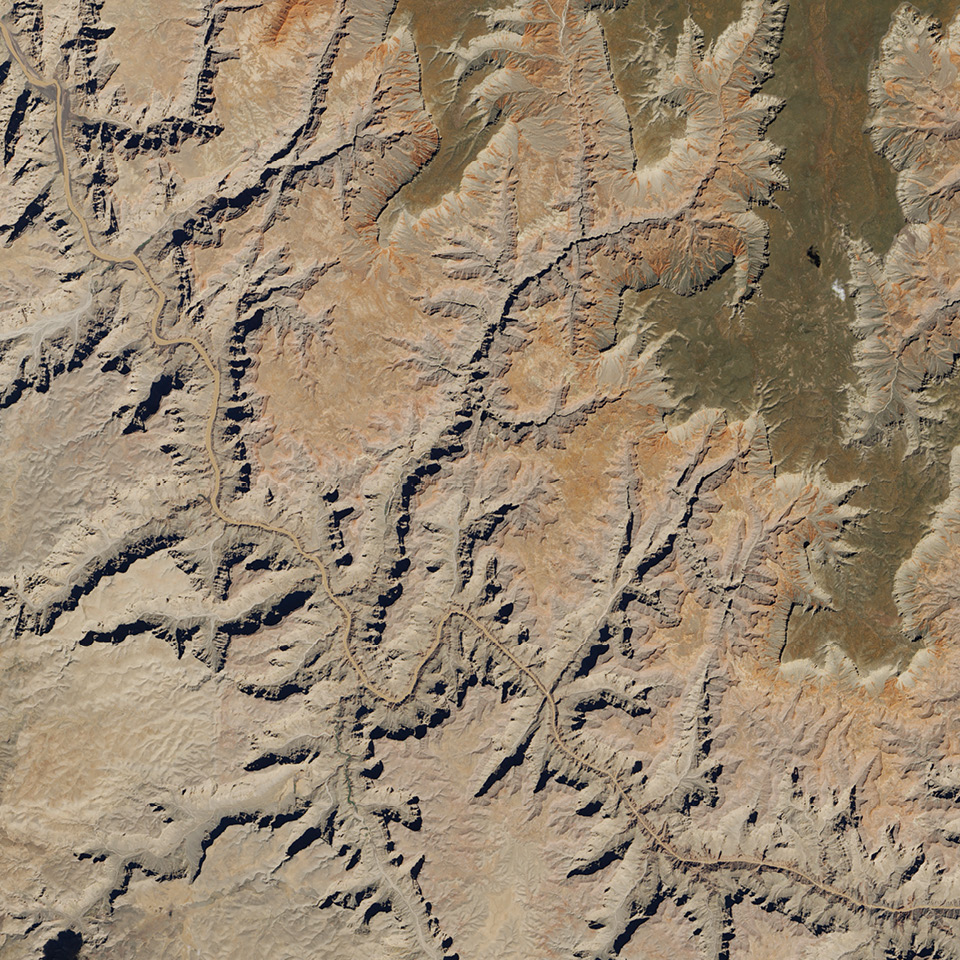
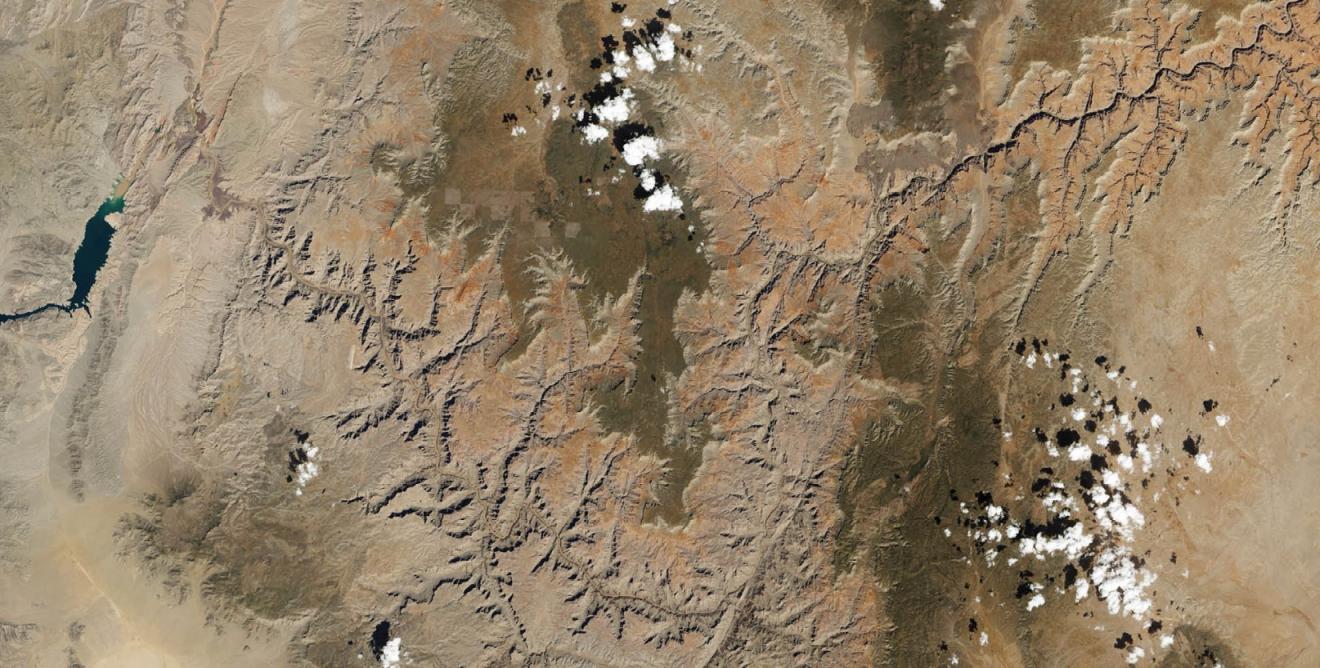
“大峡谷的奇观,无法用符号或言语充分表达。”鲍威尔在日记里写道。他看峡谷,多半是从河面往上看;那年头还没有能从太空俯瞰地貌的手段。如果有,他见到的景象大约会像 Landsat 8 在 2013 年 3 月拍下的这张。
“The wonders of the Grand Canyon cannot be adequately represented in symbols or speech,” Powell wrote in his log. Powell was seeing the canyon mainly from river level; there was no technology that provided views of the landscape from space then. If there had been, he would have seen something similar to what Landsat 8 observed in March 2013.
科罗拉多河在干旱的科罗拉多高原(Colorado Plateau)上划出一道线。没有树的地方是米色与橙色,绿色的是森林。河水浑浊发褐——这在春季很常见:融雪抬高水位,顺手多卷了一层泥沙。
The Colorado River traces a line across the arid Colorado Plateau. Treeless areas are beige and orange; green areas are forested. The river water is brown and muddy, a common occurrence in spring when melting snows cause water levels to swell and pick up extra sediment.
鲍威尔在峡谷里走了好几个月。等他到今天的米德湖(Lake Mead,见下页最左)一带,手下已经疲敝不堪,还有四个人开了小差。而科罗拉多河送水送沙,一路只要几天。
It took Powell months to navigate the gorge. By the time he had arrived in the area that is now Lake Mead (visible on the next page, far left), his men were weary and four had deserted. For water and sediment transported by the Colorado, the journey is much quicker; it takes just a handful of days.
原文:Michael Carlowicz、Lawrence Friedl、Kevin Ward《Earth》,NASA Headquarters, Earth Science,2018 年(NP-2018-05-2546-HQ;ISBN 978-1-62683-047-9)。
原文授权:依《美国法典》第 17 编第 105 条(17 U.S.C. §105),原文在美国境内不受版权保护,属公有领域(public domain)。NASA 媒体使用指南允许将其用于教育与资讯用途(含图集、教材、展陈与网页),并要求注明 NASA 为来源;商业用途另受限制。
图像:NASA Earth Observatory、NASA/USGS Landsat、国际空间站(ISS)、Suomi NPP、NASA/METI/ERSDAC/JAROS 等,均为 NASA 发布的公有领域影像;逐幅来源见原书 Credits 页。
标识:NASA 徽标(Insignia)、Logotype 与相关标识不属公有领域,受法律保护;本文未使用,亦不代表 NASA 立场。
本文:本文为非商业用途的个人独立翻译、校对与排版,不代表 NASA 立场;NASA 未审阅、未认可或背书本译文。
译文授权:译文与排版由译者独立完成,著作权归译者所有,按 GNU 通用公共许可证第 3 版(GPLv3)授权分发;许可证全文见 https://www.gnu.org/licenses/gpl-3.0.html。转载、修改或再分发请同样遵循 GPLv3。
Original work: "Earth" by Michael Carlowicz, Lawrence Friedl and Kevin Ward (NASA Headquarters, Earth Science, 2018; NP-2018-05-2546-HQ). Under 17 U.S.C. §105 the original is not subject to copyright protection in the United States and is in the public domain there. NASA media guidelines permit educational and informational reuse (image collections, textbooks, exhibits, web pages) with acknowledgement of NASA as the source, and restrict commercial use. The NASA Insignia, Logotype and identifiers are protected by law and are not used here. This edition is a non-commercial, independent Chinese translation and typesetting; it does not represent NASA. Translation and typesetting © the translator, distributed under the GNU General Public License v3.0 (https://www.gnu.org/licenses/gpl-3.0.html).